7 Steps to Learn Forex Trading Without Chasing Random Strategies
Want articles like this for your own video to promote it on YouTube and Google? Order them through the Telegram bot @sat_sit_bot. Articles with your video embedded are written and posted by the bot itself — on popular topical sites (no ads). Your first 50 articles are free.
Forex is the market where national currencies are traded against each other in pairs, and learning it means mastering three layers in order: how the market actually works (bid, ask, spread, order book, order flow), how price structure and liquidity create repeatable setups, and how risk, backtesting and journaling turn those setups into a business. A free structured starting point is the Photon Trading beginner course and cheatsheets, which pairs the theory with a downloadable reference you can keep next to your charts.
What forex trading actually is and how the market is organised
Forex is a decentralised, over-the-counter network of banks, brokers, funds and retail platforms, so there is no single exchange and no single official price. Currencies are always quoted in pairs — EUR/USD, GBP/JPY, USD/JPY — where the first currency is the base and the second is the quote, and the price tells you how much of the quote currency one unit of the base costs. The retail side is dominated by a handful of sessions: Sydney and Tokyo open the Asian range, London brings the largest volume, and New York overlaps with London for the most liquid hours of the day. That session structure matters because liquidity, spreads and volatility are not constant — the same setup behaves differently at 3 a.m. and at 3 p.m. Central European time.
Leverage is what makes forex attractive and dangerous at the same time: a broker may offer 1:30 to retail clients in regulated jurisdictions and far more offshore, which means a small account can control a large notional position. The correct way to think about leverage is not as extra buying power but as a reduction in the margin you must post — your real risk is defined by position size and stop distance, not by the leverage figure on the account.
How the bid-ask spread and order book shape every trade
Every forex quote has two sides: the bid, at which the market buys from you, and the ask, at which it sells to you, and the difference is the spread — the instant cost of entering a trade. If EUR/USD is quoted 1.08500 / 1.08512, the spread is 1.2 pips, and a long position starts 1.2 pips in the red before price moves at all. Spreads widen around news releases, rollover and thin liquidity, which is why a strategy tested on tight spreads can look profitable on paper and lose money live.
Behind the quote sits the order book: resting limit orders on one side and market orders hitting them on the other. When aggressive market buying consumes the available sell limits at a price, price must move up to the next level where sellers are willing to trade — that is the mechanical reason a level breaks. This is the core argument against pure geometric pattern reading: shapes describe the footprint, but order flow and the auction process describe the cause.
Why market structure and liquidity beat indicator stacking
Market structure is the sequence of highs and lows that tells you who is currently in control: higher highs and higher lows describe an uptrend, lower highs and lower lows a downtrend, and a break of the last opposing swing point signals a shift. Traders typically separate three structure types — internal structure inside a leg, external or swing structure on the higher timeframe, and the structure of the range that forms when neither side is in control. Reading those three consistently is what stops you from buying the top of an uptrend because a moving average crossed.
Liquidity concepts complete the picture. Price tends to travel toward pools of resting orders — equal highs and lows, previous session extremes, round numbers — because that is where stops and pending orders cluster and where large participants can fill size. Combined with premium and discount logic (buying in the lower half of a range, selling in the upper half) and multi-timeframe alignment, this gives a structural reason for a trade rather than a shape-based guess.
The four mechanics that make a trade plan work
A trade plan is a written document that specifies what you trade, when you trade, how you enter, how you exit and how much you risk — and it only counts if it can be backtested. Four components do most of the work:
- Setup definition. Name the exact conditions: timeframe, structure state, liquidity objective, entry trigger. If two traders cannot agree whether a setup existed, the definition is too vague.
- Risk per trade. A common starting point is 0.5–1% of account equity per position, which keeps a normal losing streak survivable. Risk is calculated from stop distance and lot size, not chosen by feel.
- Trade management. Decide in advance whether you move to break-even, take partials, or trail — and apply it identically in backtest and live trading, otherwise your statistics are meaningless.
- Journal fields. Record the setup, the reason for entry, the risk in currency, the result in R multiples (profit divided by initial risk), and a screenshot. R multiples let you compare trades of different sizes on one scale.
Backtesting is the step most beginners skip. Manual backtesting on historical charts — 100 to 200 trades with screenshots — produces a win rate, an average R, and a realistic sense of drawdown before any money is at stake. Execution then follows a simple routine: check the higher timeframe, mark the levels, set an alert, size the position, place the order with stop and target, and log the trade.
Choosing a broker and controlling trading costs
Broker selection is a cost and safety decision before it is anything else. Check regulation and client-fund segregation, the all-in cost of a round trip (spread plus commission), typical slippage on your instrument, swap rates for positions held overnight, minimum lot size and whether micro lots are available for a small account. A raw-spread account with a commission can be cheaper than a marked-up spread account for frequent trading, and the reverse is true for swing traders who hold positions for days. Also verify platform stability, withdrawal terms and how the broker handles news-time spread widening, because those conditions decide whether your backtested edge survives contact with live execution.
Common beginner questions and mistakes
How much can you make trading forex? Returns depend on edge, risk per trade and sample size, not on leverage. A system risking 1% per trade with a positive average R can compound quickly on a small account, but the same math produces deep drawdowns during a losing streak, so a realistic expectation is modest monthly returns with strict risk control rather than a fixed income figure.
Should you trade other people's money? Prop firm funding and managed accounts exist, but they multiply both results and mistakes, and most programmes require a verified track record before capital is allocated. Build a documented edge on your own account first.
Why does a strategy work in backtest and fail live? Usually because of spread and slippage that the backtest ignored, inconsistent trade management, or a sample so small that the result was luck. Re-test with real costs and a rule set you can follow mechanically.
Is trading psychology the first thing to fix? Psychology matters, but it is far easier to stay disciplined when the strategy is defined and tested. Master the mechanics and the edge first; then the psychological work has something concrete to protect. A related trap is consuming endless free content without applying any of it — the fix is one written plan, one instrument, and a journal you actually fill in.
Useful links
- Free Photon Trading course and cheatsheets: https://www.photontradingfx.com/free-training?el=beginnersguide&htrafficsource=YT
- Photon Trading mentorship: https://www.photontradingfx.com?el=beginnersguide&htrafficsource=yt
- Free Telegram channel with analysis and trade recaps: https://t.me/photontrading
- Instagram: https://www.instagram.com/photontrading/
Final thoughts
Forex rewards structure, not enthusiasm: understand the spread and order flow, read market structure and liquidity, then wrap it in a written plan with fixed risk, backtested statistics and a journal. The three-hour beginner guide from Matt Donlevey - Photon Trading is a useful spine for that curriculum because it moves from market mechanics to entries, management, costs and psychology in one sequence instead of scattering concepts across dozens of clips. Start with the free Photon Trading course and cheatsheets, then commit to one instrument and one setup for a full month of journaling before judging the results.
Key takeaways
- Forex is an over-the-counter market where currencies are quoted in pairs and priced through the bid-ask spread, not on a single central exchange.
- Price moves because of order flow and auction dynamics — pending orders and liquidity, not geometric chart shapes, explain why a level breaks or holds.
- A beginner needs four things before risking money: a written trade plan, backtested statistics, defined risk per trade and a journal.
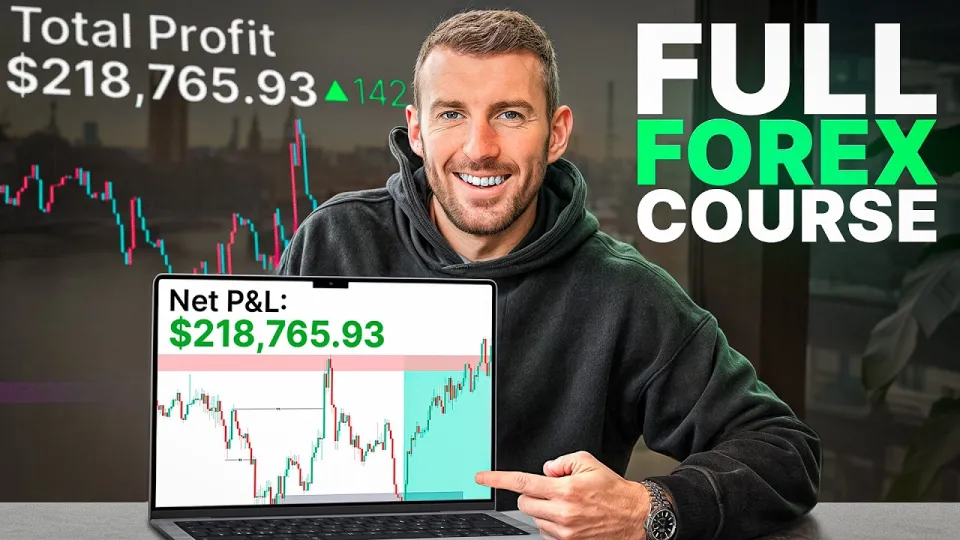
- Matt Donlevey - Photon Trading released a three-hour beginner walkthrough covering microstructure, market structure, liquidity, entries, management and psychology.
- The free Photon Trading course and cheatsheets are available at photontradingfx.com/free-training.
Source: Beginners Guide To Forex Trading In 2026 (+3 hours) · Markdown version
Questions & answers
Do I need a large account to start trading forex?
No. Micro lots let you risk a fraction of a percent on a small balance, and risk is set by position size and stop distance rather than by account size. What a small account cannot absorb is sloppy risk — 5% per trade will end the account long before the edge shows up.
How long does it take to become consistently profitable?
It depends on how fast you build and test a defined setup, but a realistic path is several months of study plus 100–200 backtested trades before going live. Consistency comes from a documented process and a journal, not from the number of videos watched.
Is technical analysis useless, as some traders claim?
Chart shapes alone explain little, because they describe the footprint of price rather than its cause. Technical analysis becomes useful when it is read through order flow, liquidity and market structure — levels matter because orders sit there, not because a pattern formed.
Why do spreads and costs matter so much for beginners?
Every trade starts behind the spread, and costs multiply with frequency. A strategy that looks profitable with zero costs can turn negative once spread, commission and slippage are included, so always backtest with realistic execution costs.