What Is a Meme Coin and Why It Beats Fundamentals-Based Bets in Short Cycles
Want articles like this for your own video to promote it on YouTube and Google? Order them through the Telegram bot @sat_sit_bot. Articles with your video embedded are written and posted by the bot itself — on popular topical sites (no ads). Your first 50 articles are free.
A meme coin is a cryptocurrency whose value comes from narrative, community attention and liquidity rather than from revenue, cash flow or a working product. That makes it a pure sentiment instrument: it can multiply in hours and go to near zero just as fast, so the only edge a trader has is understanding token supply, who is selling, and when to exit. Platforms such as FOMO bundle trading tools and copy-trading features in one place, which is useful for anyone who wants to see how experienced wallets behave before risking size.
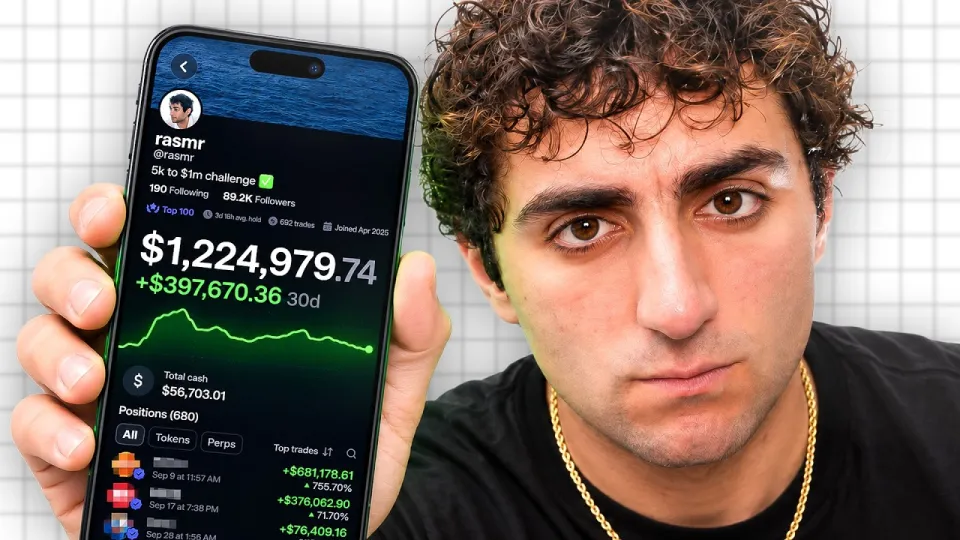
The 12-minute breakdown published by the rasmr channel compresses roughly five years of practical meme coin experience into a checklist, and much of it contradicts the instinct that gets new traders liquidated in their first month.
What actually drives a meme coin price
Price in this sector is set by supply mechanics and order flow, not by technology. Two tokens can show the same percentage gain while representing completely different amounts of money, and traders who ignore that distinction routinely misjudge how much room is left in a move.
- Check total and circulating supply before anything else. A token priced at $0.000001 with a 700 billion supply has a larger market cap than a token at $10 with a 10 million supply.
- Compare market cap, not unit price, against comparable coins in the same narrative. A $5 million cap in a sector where leaders sit at $200 million has different upside than a $90 million cap in the same sector.
- Look at liquidity depth. Thin liquidity means your own sell order moves the chart against you, so a paper gain of 300% can shrink to 60% on the way out.
- Identify the narrative. Coins tied to a live event, a person, an animal, a political moment or an AI agent trend attract buyers because the story is searchable and shareable.
Who is selling to you and why insiders exit first
Every meme coin launch has a structure, and the structure is usually the same regardless of how decentralised the launch claims to be. A small group of connected wallets, sometimes described as an inner circle, typically learns about a launch before the public does, buys at the lowest point of the bonding curve or initial liquidity pool, and then sells into the demand created when the coin trends.
That is not a conspiracy theory so much as a business model. Launchpads and trading groups profit from being early, and the public provides the exit liquidity. The practical takeaway is not to avoid these coins entirely but to know which side of the trade you are on. If you are buying a coin that has already run 40x and is being promoted across every feed, you are not early — you are the demand.
Useful signals of late entry include a chart that has gone vertical within minutes, a market cap that already sits in the tens of millions with no prior consolidation, and a wave of identical posts from accounts created recently. Conversely, an early entry usually looks boring: low cap, thin volume, an unclear chart and a narrative that has not been picked up yet.
Why emotions cost more than bad picks
The single most repeated lesson from traders who have survived several cycles is that emotional decisions destroy accounts faster than wrong token choices. The pattern is consistent: a position goes up 50–100%, the trader refuses to take profit because the chart looks strong, the price round-trips to the entry, and the same trader then holds a loser hoping for a bounce.
Three rules address this directly.
- Decide the exit before entering. Write down the market cap or percentage at which you sell a portion, and the level at which you accept the loss. A plan made before the position exists is not influenced by the position.
- Scale out, don't all-out or all-hold. Selling 25–50% into strength locks in real money while leaving exposure to a further run. Round-tripping an entire unrealised million is the most common regret in the sector.
- Never average down on a broken narrative. Adding to a losing meme coin converts a small planned loss into an unplanned large one, because the reason you bought has usually already disappeared.
A separate trap is boredom trading. When a coin is flat, traders rotate into random low-cap launches and pay spread and slippage on every rotation. Fewer, better-researched positions beat constant activity.
A practical checklist before buying any meme coin
A repeatable process matters more than a hot tip, because the same process can be applied to hundreds of launches. The checklist below covers the questions that decide whether a trade is worth taking.
- Narrative: can you explain the coin in one sentence, and is that sentence currently interesting to a large audience?
- Age and chart: is the coin minutes old, hours old or days old? Older coins with a surviving community are lower risk than fresh launches with no holder base.
- Holder distribution: are the top wallets clustered and funded from the same source? Concentrated holdings mean one wallet can end the chart.
- Liquidity and taxes: check for hidden transfer taxes, mint authority and whether liquidity is locked or has already been pulled.
- Your size: can you accept a total loss on this position without changing your behaviour on the next ten trades? If not, the position is too large.
Common questions traders ask about meme coins
Most doubts in this niche repeat across every cycle, and the questions raised by viewers of the rasmr breakdown are a good sample. New traders want to know how to spot a rug pull, whether a small account can participate meaningfully, and whether a coin tied to a future event — a game release, for example — is a legitimate investment.
The honest answers are less satisfying than the questions. Rug detection is probabilistic, not certain: locked liquidity, renounced mint authority, distributed holders and a chart that has not been artificially pumped all reduce risk without eliminating it. Small accounts can participate, but the edge comes from discipline rather than size, since a 30% gain on a small position teaches the same lesson as a 30% gain on a large one. And event-based coins are simply narrative bets with a known expiry date — they work only if you exit before the event, because the story is fully priced once it happens.
Risk controls that keep a meme coin account alive
Survival in this market is a function of position sizing and diversification across attempts, not of picking one perfect coin. A trader who risks 2–5% of the account per position can be wrong twenty times in a row and still be trading; a trader who risks 50% per position is finished after two mistakes.
It also helps to separate capital. Keep the majority of funds in established assets and allocate a defined, expendable portion to high-risk launches. That structure prevents a single bad trade from forcing a decision made under pressure, which is exactly when emotional mistakes happen.
Useful links
Bottom line
A meme coin is a sentiment trade dressed as an investment, and treating it as anything else is how accounts get wiped. The mechanics that matter are supply, market cap, liquidity and the identity of the sellers on the other side of your order. The rasmr channel's twelve-minute summary is a useful primer precisely because it focuses on process — pre-planned exits, scaled profit-taking, controlled position size — rather than on picking winners. Anyone starting with a small account should internalise those rules first and treat every launch as a bet they can afford to lose. If you want to follow the flow of experienced wallets while you learn, you can register on FOMO via this link and study the trades before committing capital.
Key takeaways
- A meme coin is a token whose price is driven by narrative, community and liquidity rather than cash flow, revenue or product usage.
- Supply and market cap matter more than unit price: a $0.000001 token with a 700B supply can be worth more than a $10 token with a 10M supply.
- Most launches follow the same path: early insiders buy at the bottom of the curve, the public buys the breakout, insiders exit into that demand.
- The most common way traders lose money is round-tripping unrealized profit while waiting for a higher price.
- Position sizing, a pre-set exit plan and zero emotional averaging down are the three controls that keep meme coin trading survivable.
Source: 5 Years of Memecoin Knowledge in 12 Minutes · Markdown version
Questions & answers
How do I tell if a meme coin is about to rug?
There is no certain signal, but several reduce risk: liquidity locked or burned, mint authority renounced, top holders not funded from a single wallet, and a chart without an artificial vertical spike. A coin promoted heavily right after a 40x move is far more likely to be an exit than an opportunity.
Can I trade meme coins with a small account?
Yes, and size is less important than discipline. Risking a fixed small percentage per position lets you survive a long losing streak, while a large single bet ends the account after one or two mistakes. Gains in percentage terms teach the same lessons regardless of capital.
Why do so many traders round-trip their profits?
Because selling into strength feels wrong while the chart is still rising. Without a pre-set plan, the position turns a 100% gain into a hope for 300%, and the price often returns to the entry before the trader acts. Scaling out in portions solves most of this.
Is a coin tied to a game or event release a good investment?
It is a narrative bet with a known expiry date. Such coins can run hard into the event, but the story is fully priced once the event happens, so the trade only works if you exit before the crowd does.